Home » Articles posted by Anttu Lein (Page 9)

Author Archive

wastewater to energy
water treatment plant

Wastewater management plants currently serve one purpose, and that is to clean a water supply for reuse in non human consumption needs. Up until now these water treatment plants have been a consumer of electricity on the power grid but research into microbes could have changed what we once knew about water treatment plants. Would it be possible for these treatment plants to power themselves? Biologists think this may be possible in the near future.

Research out of Oregon State University conducted by engineers and biologists has developed a new technology that utilizes microbes which digest waste water to power a microbial fuel cell. Although microbial fuel cells have existed in the past they have been largely inefficient for the cost and space they require. The application of this new microbial fuel technology is estimated to be between 10 to 50 times more effective than its predecessors and can be implemented into existing water treatment plants.

This research will most likely have a dramatic affect on the design and usage for wastewater facilities around the world, which currently is divided into 3 stages of treatment. The use of microbial fuel cells is predicted to eliminate the stage which treats activated sludge. In addition to this replacement, implementation of this technology would allow these facilities to produce power for the grid instead of consuming it.

Is water treatment a reliable energy source?

wastewater energy

It is currently estimated that approximately 3% of the energy consumed in the United States of America is used towards water treatment facilities. Although this source of power may not be sufficient to replace existing energy resources, it is a step in eliminating energy usage created from fossil fuel sources while producing some additional power to alleviate consumption needs in an environmentally friendly process.

It is theorized by some biologists and engineers that once further research is conducted into improving the efficiency of these fuel cells, this can become a fairly reliable power source without emitting greenhouse gasses. The technology has already been tested and proven on a small scale so current operations are underway to develop usage in a commercial market.

microbial fuel cell

How does it work?

Aerobic bacteria are being used in existing power, however the new process would utilize bacteria which oxidizes organic matter in waste which produces electrons to create a charge that is transferred into the battery of the fuel cell. The knowledge of bacteria’s ability to produce electricity has been known for a few decades, it is recently being applied into usage for generating and capturing energy.

The availability of this new technology would revolutionize developing nations which have a lack of power and are unable to build water treatment facilities in remote regions. Whatever potential this energy solution may hold for the future, it is certain that this research has only just reached its break through moment and has a much more work required to refine and harness the full potential of the energy synthesis from microbial fuel cells. Although proven capable to generate electricity, this technology is still very far from being considered the next major energy solution.

atmosphere layers

atmospheric layers

Atmosphere Layers of Earth

The atmospheric layers of the Earth serve distinct functions and are essential for maintaining the ability to support life on this planet. These layers of the atmosphere serve to regulate heat distribution, wind, deflection of solar radiation and the containment of essential gases. In order to understand how our planet can support life, it is essential to first explore the relationship of our atmosphere to the relatively mild conditions our life can enjoy on the planet Earth.

Troposphere

The Troposphere is located approximately 6 to 20 km above the Earth’s surface. Weather variation is known to shift the placement of this layer and is a gradient of temperature radiating off of the Earth’s surface. The lower portions of the Troposphere retain the most heat which slowly dissipates as altitude climbs in this layer. Within the Troposphere approximately 80% of the atmospheric mass for the Earth can be found making this the densest layer.

The Troposphere contains 99% water vapor along with aerosols and is responsible for the world’s precipitation and maintaining Earth’s balance of temperatures. This atmospheric layer is most commonly where weather phenomenon occurs and its height can shift due to the changing air temperatures and pressures in different parts of the world at varying times throughout the seasons.

tropopause

Tropopause

The Tropopause is the edge of the Troposphere and the Stratosphere and contains the coolest temperatures for both layers. Finding the temperature variation for the Troposphere can be done by by using a mathematic formula specific for this measurement.

Environmental Lapse Rate (ELR)

The Environmental Lapse Rate or ELR is the formula used to calculate the variation of temperature decrease with altitude increase in the Troposphere (-dT / dz).

stratosphere

Stratosphere

The Stratosphere begins just after the Troposphere and is located approximately 20 to 50 km above the Earth’s surface. Like a mirror opposite to the Troposphere, the Stratosphere’s heat gradient begins cooler and increases with altitude. The edge of the Stratosphere absorbs a large portion of ultra-violet radiation producing heat at its apex which is the main factor in these temperature variations.

Ozone Layer

The Ozone Layer is one of the most commonly referred to atmospheric layers although it is in actuality a sub section of Stratosphere. The Ozone is contained at the lower most portions of the Stratosphere and is particularly dense compared to the atmosphere surrounding it. The density of the Ozone differs throughout the year due to geographic positioning and seasonal placement.

The Ozone Layer is known for its ability to absorb solar radiation making it possible for life to exist on the Earth without being exposed to deadly levels of radiation.

Stratopause

This term is used for the thin layer where the Stratosphere and the Mesosphere meet. Atmospheric pressure in the Stratopause is about one one-thousandth of the pressure found at sea level.

mesosphere

Mesosphere

The Mesosphere is located approximately 50 to 85 km above the Earth’s surface. The top layer of the mesosphere is referred to as the mesopause which is recorded to be the coldest place on the planet Earth. As altitude increases in the mesosphere the temperature decreases which is referred to as the thermal gradient of the mesosphere.The mesosphere helps to govern global circulation of tides and wind, although these forces are largely effected on a local scale from the stratosphere and troposphere.

Mesopause

The mesopause is at the pinnacle of the mesosphere’s thermal gradient and is the coldest section of the Earth’s atmosphere.

Thermosphere

The Thermosphere is located approximately 85 to 690 km above the Earth’s surface. Inside the Thermosphere layer lies the Ionosphere which many know as the responsible force behind the Aurora Borealis. The thermosphere has the opposing thermal gradient signature as the mesosphere, where temperatures begin at their coldest and gradual get warmer with altitude. Within this layer solar radiation is iodized to create the heat variations while residual gases form into visible layers by density.

Although temperatures are higher with altitude in this layer, they are not physically felt in the same manner as they would on the planet’s surface. The reason this occurs is because the gas particles are spread so far apart that heat is not diffused the same way it is near the Earth’s surface.

Ionosphere

The Ionosphere is located within the Thermosphere approximately 100 km above the Earth’s surface. This layer of the atmosphere becomes charged or ionized when solar radiation comes in contact with it. It helps to regulate and distribute electrical currents in the atmosphere and is used by humanity to transmit signals, most notably radio waves.

exosphere

Exosphere

The Exosphere is located approximately 690 to 10,000 km above the Earth’s surface. This area has a very low density where particles almost never collide with each other. The exosphere serves to keep energetic particles from escaping the atmosphere and gravitational influence of the Earth. This layer is largely responsible for trapping in the gases our planet requires to contain biodiversity.

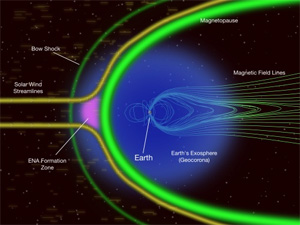
Magnetosphere

The magnetosphere is an area the magnetic field of Earth deflects a stream of particles from solar wind creating a layer of the deflected materials. Of the planets in our solar system, currently Earth, Jupiter, Mercury, Saturn, Neptune and Uranus have magnetospheres while the ionospheres on the plants of Mars and Venus are too weak to actually form this atmospheric layer.